Mon-Sat: 8:00am-7:00pm

Tell us about your Round Rock home and the attic service you want evaluated.
Round Rock sits directly on the Balcones Escarpment, and that line runs straight through the city’s housing. Neighborhoods east of it were laid out on flat blackland prairie; the western side climbs into hill country. What matters in the attic, though, is timing rather than terrain. Much of the core city — the 78664 and 78681 ZIP codes — filled in through the 1970s, 1980s and 1990s, and Texas had no mandatory statewide residential energy code until September 1, 2001.
That single date explains a lot of what we find above Round Rock ceilings. A home finished before it met whatever insulation level its builder chose to install, with nothing requiring more. Homes built between 2001 and 2016 were held to earlier code editions that asked for less than the R-38 ceiling value Central Texas requires today. Neither situation is a defect. It simply means the attic reflects the standard of its year, not the standard now.
Choose the service to learn more, or request an attic evaluation if you are unsure which option fits your home.
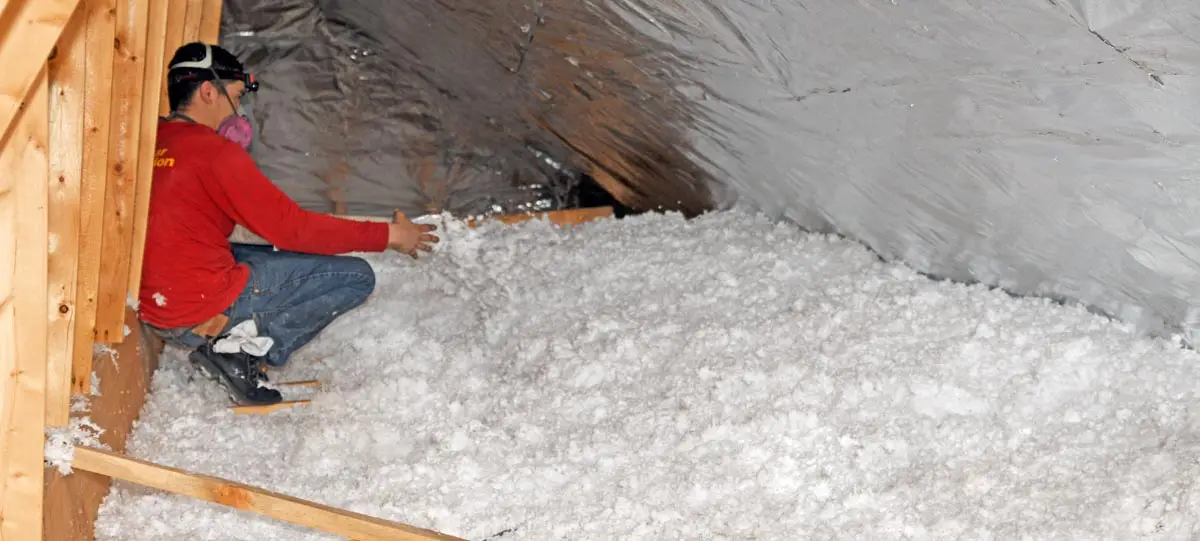
Blown-in fiberglass can improve coverage across open attic floors, while fiberglass batts can be fitted in accessible framing areas where their shape and placement make sense. We evaluate existing depth, gaps, compression and obstructions before recommending either approach.
Radiant barrier foil is installed along suitable roof framing to reduce radiant heat transfer from the roof deck into the attic. It can complement—not replace—proper attic-floor insulation when the attic configuration supports a professional installation.
Removal may be appropriate when insulation is contaminated, badly damaged, heavily disturbed or blocking access needed for other attic work. We define the removal scope clearly and discuss replacement insulation separately so homeowners understand the complete project.
Round Rock is really several housing markets stacked inside one city limit, and each one shows up differently in the attic.
The pre-code core. Round Rock West dates to the 1970s — quarter- to three-quarter-acre lots, no HOA, and mature heritage trees shading much of the neighborhood. Homes there are now fifty years old and were insulated to no required standard at all. In attics of this vintage we usually find loose-fill that has settled well below its original depth, plus decades of foot traffic worn into paths between the access hatch and the equipment.
The 1990s and early-2000s build-out. Chandler Creek, Forest Creek, Hidden Glen and Sonoma filled in through this stretch. These attics were insulated under either no code or the 2000 IECC, and the common issue is not age so much as disturbance — twenty-plus years of HVAC service calls, re-wiring, cable and satellite work, and attic storage that compresses material flat wherever someone knelt or set a box down.
The newer northeast side. The 78665 ZIP is Round Rock’s newest, and it carries Teravista — 3,400-plus homes started in 2001 and extending into Georgetown — along with Behrens Ranch, Mayfield Ranch from 2008 and Vizcaya in the 2010s. Homeowners here are often surprised to need attic work at all. The honest answer is that anything finished before September 2016 predates the current R-38 ceiling requirement, and larger two-story plans with attic-mounted equipment concentrate a lot of summer heat directly above the living space regardless of what year they were built.
How to check your own attic in about two minutes. You do not need to climb in, and you do not need us, to get a rough answer. Open the attic hatch, shine a light across the attic floor and find the ceiling joists — the framing running across the space. If you can see the tops of those joists, or the insulation sits roughly level with them, you are almost certainly well short of R-38. Reaching R-38 with blown fiberglass generally takes somewhere in the range of twelve to sixteen inches of settled depth, which sits noticeably above typical framing. While the light is up there, look for bare patches near the eaves, a worn path between the hatch and the air handler, and areas that were obviously pushed aside for HVAC or wiring work and never put back.
The symptoms that usually match what we find. Rooms on the west or south side that will not hold temperature through the late afternoon. A second floor that runs several degrees warmer than the first. An air conditioner that runs continuously through the evening without the house actually catching up. Ceilings that feel warm to the palm at six in the evening. None of those prove an insulation problem on their own — duct condition, air leakage and equipment age all matter too — but combined with what you saw at the hatch, they are worth a free evaluation.
We keep the process practical: evaluate visible attic conditions, explain suitable options and complete the approved scope with care.

We review visible insulation depth, coverage, condition, access and the areas affected by past service work.
You receive a clear explanation of suitable materials, preparation needs and why a particular option fits the attic.
Our crew protects the access path, completes the agreed installation or removal scope and reviews the finished work.
All of them, across 78664, 78665 and 78681 — Round Rock West, Chandler Creek, Forest Creek, Teravista, Behrens Ranch, Hidden Glen, Sonoma, Cat Hollow, Mayfield Ranch, Vizcaya, Paloma Lake, Sendero Springs and the rest. Give us the property address when you request an estimate and we will confirm scheduling.
Open the hatch and shine a light across the attic floor. If you can see the tops of the ceiling joists, or the insulation is level with them, you are well short of the R-38 standard — that generally takes twelve to sixteen inches of settled blown fiberglass, which sits clearly above the framing. Pair that with rooms that will not hold temperature in the late afternoon and it is worth having someone look properly.
We will not put a number on a web page, because the honest answer depends on things we have to see: the square footage of the attic floor, how accessible it is, whether existing material has to come out first, which service you choose, and how much work is needed at the eaves and around obstructions. Attic size and whether removal is required are the two biggest drivers. A 1,400-square-foot single-story in Round Rock West and a 3,000-square-foot two-story in Teravista are not close to the same job. The evaluation and the written estimate are free, and you get the scope in writing before anyone starts.
Usually some, but rarely what it started with. Texas had no mandatory statewide residential energy code before September 1, 2001, so a 1970s Round Rock West home was insulated to whatever the builder chose. Loose-fill also settles over fifty years, and settled material is thinner than installed material. We measure actual depth in several places rather than assuming from the year.
Two reasons. The R-38 ceiling value required in Central Texas today has only applied since September 1, 2016, so a 2001-2015 home met a lower standard when it was built. And twenty years is long enough for HVAC service, wiring and storage to disturb coverage even when the original installation was fine.
Most straightforward installations are a single day, and the crew works from the attic access rather than through your living space wherever possible. Removal jobs and difficult access take longer. We protect the access path, and we will tell you before we start what the day will actually look like rather than after.
We can evaluate insulation affected by roof damage, water intrusion or repair work. If the roof deck itself was compromised, that repair comes first — there is no point installing new material under a roof that still needs work. We will tell you plainly if the sequence needs to change.
Tell us which service interests you and what you have noticed in the attic or living space. We will confirm service availability in Round Rock and discuss the next step.