Mon-Sat: 8:00am-7:00pm

Tell us about your Kyle home and the attic service you want evaluated.
Kyle is the fastest-growing city we serve and, for practical purposes, a post-2000 city. It had under 6,000 residents in 2000 and is estimated past 62,000 now. Almost every home in the 78640 ZIP code was built after that turn, in two distinct waves — the Plum Creek and Hometown Kyle build-out through the 2000s, and a second surge from about 2016 onward.
New does not automatically mean finished, though. The R-38 ceiling value this climate zone requires today has only applied to homes permitted since September 1, 2016, which means Kyle’s entire first wave was built to a lower standard than the second. A house from 2006 is now approaching twenty years old and was insulated under the 2000 IECC, not the code in force today.
Choose the service to learn more, or request an attic evaluation if you are unsure which option fits your home.
Blown-in fiberglass can improve coverage across open attic floors, while fiberglass batts can be fitted in accessible framing areas where their shape and placement make sense. We evaluate existing depth, gaps, compression and obstructions before recommending either approach.
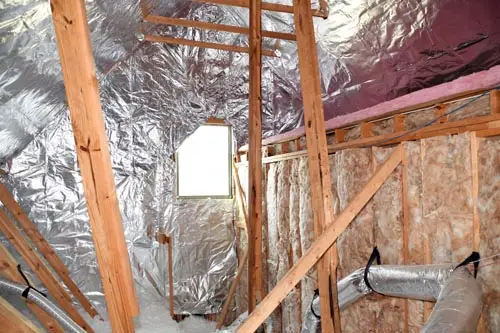
Radiant barrier foil is installed along suitable roof framing to reduce radiant heat transfer from the roof deck into the attic. It can complement—not replace—proper attic-floor insulation when the attic configuration supports a professional installation.
Removal may be appropriate when insulation is contaminated, badly damaged, heavily disturbed or blocking access needed for other attic work. We define the removal scope clearly and discuss replacement insulation separately so homeowners understand the complete project.
Plum Creek is unlike anything else in the metro, and it changes how we approach a job. Development began in the late 1990s across roughly 2,200 acres, planned on New Urbanist lines: narrow lots, front porches, and garages loaded from rear alleys rather than the street. Homes run from about 1,059 to 2,854 square feet. What that means on site is tight side setbacks, alley-side access, and equipment placement that differs from a conventional suburban lot. It is not a problem — it just means we plan the approach before the truck arrives rather than after.
Plum Creek’s oldest homes are now around twenty-five years old and were built before Texas had any mandatory statewide residential energy code, which took effect September 1, 2001. In attics of that age the recurring findings are settled loose-fill sitting below its installed depth and compressed paths worn between the access hatch and the air handler.
Hometown Kyle built from 2004 to 2016 with homes from roughly 1,700 to 3,400 square feet, and it sits almost entirely on the pre-2016 side of the current standard. Cypress Forest, 6 Creeks, Sage Hollow, Paramount, Cool Springs, Anthem, Brooks Ranch, Crosswinds and Casetta Ranch represent the newer wave, where builder installations are more likely to meet current requirements — but where we still check whether coverage is even, whether the eaves and attic platforms were finished properly, and whether anything has been disturbed since handover.
Check it yourself in about two minutes. Open the attic hatch and shine a light across the floor. If you can see the tops of the ceiling joists, or the insulation sits level with them, you are well short of R-38 — that generally takes twelve to sixteen inches of settled blown fiberglass, which sits clearly above the framing. Then look at the eaves and around the attic platform, and check whether anything was pushed aside during a duct, water heater or wiring service call. In a city where most homes are under twenty-five years old, disturbance is a more common cause of poor performance than age.
The symptoms that go with it. Rooms that will not hold temperature through the late afternoon. An upstairs running several degrees warmer than downstairs. An air conditioner that runs and runs through the evening without the house catching up. Warm ceilings at six o’clock. None of those prove an insulation problem by themselves, but combined with what you saw at the hatch they are worth a free evaluation — and if we find the attic is already in good shape, we will tell you that instead.
We keep the process practical: evaluate visible attic conditions, explain suitable options and complete the approved scope with care.

We review visible insulation depth, coverage, condition, access and the areas affected by past service work.
You receive a clear explanation of suitable materials, preparation needs and why a particular option fits the attic.
Our crew protects the access path, completes the agreed installation or removal scope and reviews the finished work.
All of 78640 — Plum Creek, Hometown Kyle, Cypress Forest, 6 Creeks, Sage Hollow, Paramount, Cool Springs, Anthem, Brooks Ranch, Crosswinds, Stagecoach Crossing, Casetta Ranch and the surrounding area. Include the property address with your estimate request so we can confirm scheduling.
Open the hatch and shine a light across the attic floor. If the tops of the ceiling joists are visible, or the insulation is level with them, you are well short of R-38 — which generally takes twelve to sixteen inches of settled blown fiberglass. Then check the eaves and the area around the attic platform, and look for anything pushed aside during a service call. In Kyle, where most homes are relatively new, disturbance is a more common problem than age.
We will not publish a number, because it depends on what we find: attic floor square footage, access, whether existing material has to come out first, and which service you choose. Plum Creek homes run from about 1,059 to 2,854 square feet and Hometown Kyle up to 3,400, so the same job varies widely across this city. Attic size and removal are the two biggest drivers. The evaluation and the written estimate are free, and you get the full scope in writing before anything starts.
It affects access more than the attic itself. Plum Creek was designed on New Urbanist lines with narrow lots, front porches and rear-alley garages, so side setbacks are tight and the practical approach to the house is often from the alley. We plan for that in advance. Plum Creek homes also date back to around 1999, before Texas required any insulation standard.
Not for the current standard. The R-38 ceiling requirement has only applied to homes permitted since September 1, 2016, so a 2008 house met the 2000 IECC instead. It is also now around seventeen years old, which is enough time for HVAC replacement, duct work, wiring and attic storage to have compressed or displaced material regardless of how good the original install was.
Possibly not, and we will say so if that is what we find. Homes permitted since September 2016 were built to the current ceiling value. What we still check is evenness — builder installations are not always uniform at the eaves, around attic platforms and at difficult roof intersections, even when average depth is correct.
No. The estimate and attic evaluation are free. Tell us which service interests you and what you have noticed — warm rooms, visible insulation problems, contamination, or planned attic work — and we will look at what is actually up there before recommending anything.
Tell us which service interests you and what you have noticed in the attic or living space. We will confirm service availability in Kyle and discuss the next step.