Mon-Sat: 8:00am-7:00pm

Tell us about your attic and we will contact you to discuss radiant barrier installation options.
Radiant barrier foil is designed to address one of the biggest sources of summer attic heat: radiant energy moving from a sun-heated roof deck into the attic space below. Traditional insulation slows conductive heat flow, but it does not perform the same job as a reflective radiant barrier.
Austin Radiant Barrier & Insulation installs reflective foil along accessible roof framing so it faces an air space and can reduce radiant heat transfer. The goal is to lower the radiant heat load affecting the attic, ductwork and insulated ceiling assembly during Central Texas cooling season.
Radiant barrier is not a replacement for attic-floor insulation. The two products work differently and are often most effective as complementary parts of an attic improvement plan. We evaluate the existing insulation, roof framing, ventilation and accessibility before recommending foil installation.
When sunlight heats the roof, the underside of the roof deck radiates energy toward cooler surfaces inside the attic. Reflective foil has a low-emittance surface that reduces the amount of radiant energy transferred across the adjacent air space.
Correct installation matters. The reflective surface needs to face an air space; sandwiching foil tightly between solid materials defeats the intended radiant-barrier function. Placement must also respect attic ventilation paths, access points and mechanical equipment.
Reducing radiant heat transfer can help moderate attic conditions and lessen the heat load affecting ducts and the rooms below. Actual results vary with roof exposure, attic design, existing insulation, HVAC configuration and homeowner usage. We provide realistic recommendations rather than promising a fixed temperature or utility-bill reduction.
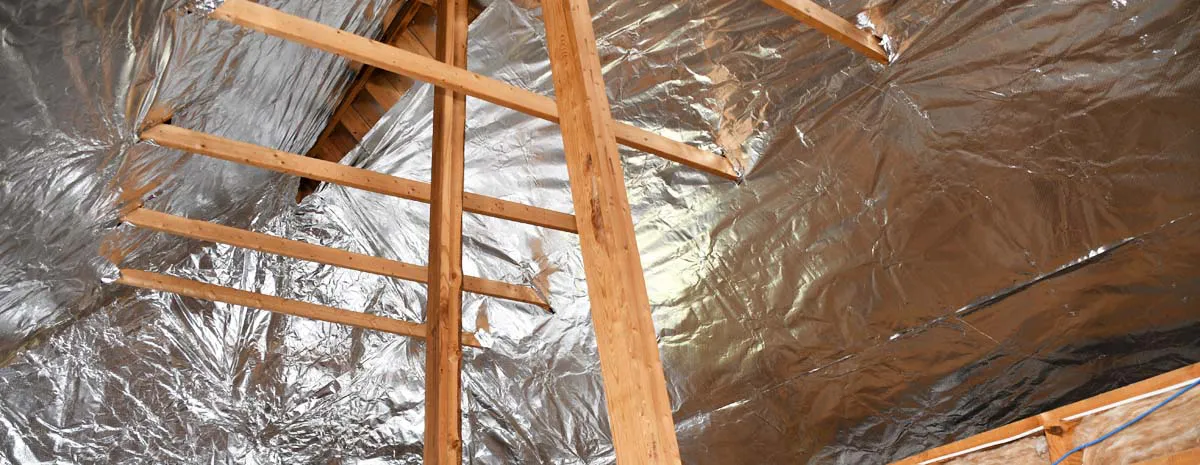
Reflective insulation is not new, and it is not experimental. The principle behind it — a low-emissivity metal surface facing an air gap — was patented in 1925, and foil insulation was being manufactured and sold to American builders by 1939.
What made it famous came later. A spacecraft has no atmosphere around it to carry heat away, so nearly all heat transfer happens by radiation. That makes reflective films the primary thermal control tool rather than a supporting one, and NASA has used aluminized reflective materials for spacecraft thermal control since the earliest days of the space program. NASA lists radiant barriers among its documented spinoff technologies, and states that the metallized emergency “space blanket” was first developed by the agency in 1964.
The same physical property is doing the work in your attic. Aluminum radiates almost no heat from its own surface, which means it reflects nearly all the infrared energy striking it. Installed facing an air space beneath a sun-heated roof, it sends far less heat down toward your ceiling.
Worth being clear about two things: NASA does not endorse commercial products, and no insulation is NASA-approved. And a radiant barrier is not insulation — it carries no R-value and works alongside your attic-floor insulation rather than replacing it. If you want the full story, including what Department of Energy and Oak Ridge National Laboratory research measured in hot climates, we covered it in detail: does radiant barrier really work?
The best candidates are accessible attics with appropriate roof framing and sufficient air space for the reflective surface. We explain when radiant barrier makes sense and when insulation, air sealing or another improvement deserves priority.

Our company has decades of insulation-industry experience and focuses on practical attic solutions suited to Central Texas homes.
We inspect accessibility, framing, ventilation and existing insulation before recommending foil.
The reflective surface is positioned to face an air space so the radiant barrier can perform as intended.
We explain what radiant barrier addresses, what it does not address and how it fits with insulation.
We evaluate roof framing, access, ventilation paths and existing attic conditions.
We determine practical foil placement, attachment method and areas requiring special attention.
The foil is secured along the planned roof-framing areas, followed by a coverage and cleanup review.
No. Fiberglass insulation slows conductive heat flow through the ceiling assembly. Radiant barrier foil reduces radiant heat transfer from the roof structure. Many attics benefit from having both products perform their separate jobs.
The critical requirement is that a reflective surface faces an air space. Foil pressed tightly between solid materials will not function as intended as a radiant barrier.
It should not. Installation must preserve soffit, ridge and other ventilation paths. We account for visible ventilation components when planning foil placement.
We typically install foil along roof framing rather than laying it across attic-floor insulation. Floor applications can collect dust and may create other concerns, so the attic design should guide placement.
Quality foil is a durable material when it remains properly secured and protected within the attic. Its performance does not depend on a coating that must be reapplied.
Request a free radiant barrier estimate for your Austin home. We will review the attic and explain whether reflective foil belongs in your insulation plan.