Mon-Sat: 8:00am-7:00pm

If someone has told you that radiant barrier foil came out of the space program, that is broadly true — and it is also the least interesting thing about it. The technology is older than NASA, better documented than most people assume, and what it actually does in an Austin attic depends on things that rarely make it into a sales pitch.
So here is the honest version. Where the technology came from, how it works, what federal researchers measured when they put it in real houses in hot climates, and how to tell whether it belongs in yours.
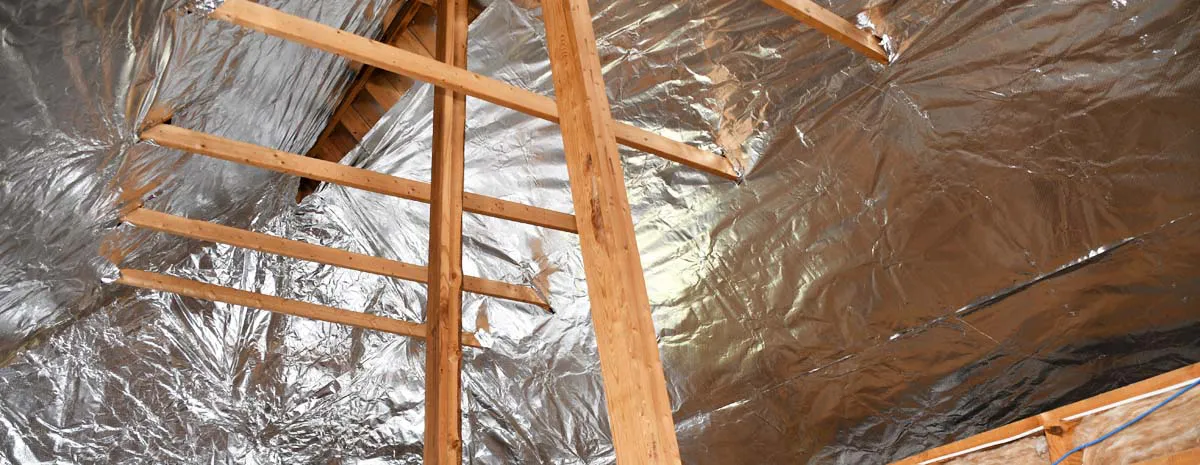
Radiant barrier is neither a miracle product nor a gimmick. It is a well-understood piece of building physics that does one specific job very well and other jobs not at all. Knowing the difference is what separates a purchase that pays you back for decades from one that disappoints.
The principle behind radiant barrier was patented in 1925.
Ernst Schmidt and Eduard Dyckerhoff filed a patent that year describing metal foil held at a distance from the surface being protected — using the bright metal face to reflect heat radiation, while the thinness of the foil itself limited how much heat could conduct through it. That is the entire idea, complete: a low-emissivity surface facing an air gap. It was on paper thirty-three years before NASA existed.
By 1939 it was a commercial building product in the United States. A patent granted that November to Roy J. Scott, assigned to the ALFOL Insulation Company, described crumpled aluminum foil sheets arranged in spaced layers to form insulating air spaces. Foil insulation was being manufactured and sold to American builders before the Second World War.
So when you hear that radiant barrier is space-age technology, the more accurate statement is that the space program adopted an already-proven idea and pushed it harder than any building application ever had.
NASA’s contribution was not invention. It was proof, under conditions no attic will ever face.
A spacecraft has no atmosphere around it to carry heat away. In orbit, essentially all heat transfer happens by radiation — which makes reflective films the primary thermal control tool rather than a supporting one. NASA has used aluminized reflective materials for spacecraft thermal control since the earliest days of the space program: the reflective skin of the Echo satellite, the Skylab sunshield, and the metallized films that hold equipment at survivable temperatures as it swings between direct sun and deep shade within minutes.
NASA also states plainly that space blankets — the thin metallized emergency sheets now found in every first-aid kit — were first developed by the agency in 1964. And NASA lists radiant barriers among the documented spinoff technologies in its own Spinoff publication.
One clarification worth making, because it gets misused in this industry: NASA does not endorse commercial products, and it does not verify any manufacturer’s performance claims. There is no such thing as NASA-approved insulation. What is true, and genuinely useful to understand, is that the foil in an attic and the film on a spacecraft rely on exactly the same physical property.
Heat moves three ways. Conduction carries it through solid material. Convection carries it in moving air. Radiation carries it across open space as infrared energy, and needs no air at all.
Fiberglass and cellulose are built to slow conduction and convection. That is what R-value measures. They do comparatively little about radiation.
And radiation is the dominant problem in a Texas attic in August. Your roof absorbs sun all afternoon, the decking heats well past the surrounding air temperature, and that hot surface radiates infrared energy downward across the attic. Insulation lying on the attic floor absorbs that energy and, eventually, passes it into your ceiling.
A radiant barrier interrupts that transfer before it starts. Aluminum has very low thermal emissivity, meaning it radiates almost no heat from its own surface — which is the same as saying it reflects nearly all the infrared energy striking it. Installed facing the attic, it turns the underside of a blazing roof assembly into a surface that sends far less heat down into the space below.
Two details decide whether it works at all.
It requires an air gap. The reflective face must have open air next to it. Foil pressed flat against a hot surface has nothing to reflect across — it simply conducts heat into itself and re-radiates it out the other side. This is the single most common installation failure in the trade.
It is not insulation, and it has no R-value. The EPA has stated that radiant barrier products do not carry an R-value, because the convective air movement in an open attic cannot be meaningfully quantified. The Federal Trade Commission has stated that no generally accepted test procedure exists to determine one. If a company advertises an R-value for radiant barrier foil, they are quoting you a number two federal agencies say cannot be measured. A radiant barrier works alongside insulation. It does not replace it, and any honest contractor will tell you so before taking your money.

Radiant barrier is one of the more heavily studied products in American residential construction, largely because the Department of Energy and Oak Ridge National Laboratory spent years measuring it in occupied houses rather than laboratories.
A DOE and Oak Ridge field study of eight Florida homes measured 9 percent cooling energy savings and a 16 percent reduction in peak cooling load after a radiant barrier retrofit. Peak load is worth paying attention to in Texas — that is the hottest stretch of the afternoon, when your system is working hardest and struggling most.
DOE’s Building America program, through Pacific Northwest National Laboratory, reports that radiant barriers can cut cooling costs between 8 and 12 percent in hot climates, while noting they are seldom cost-effective in cold or marine climates. Austin is not a marginal case here. Central Texas is precisely the climate the research points to.
Oak Ridge’s own 2010 analysis put annual savings in the hottest US climate zones — which include Austin — at roughly $50 to $150 per year, and found the spread between homes was wide for a reason we will come to next.
And in a measured South Texas study, researchers at Texas A&M’s Energy Systems Laboratory installed radiant barriers in occupied units with 1970s-era attic insulation and recorded an average 60 percent reduction in daily ceiling heat load. That figure is heat load, not a utility bill, and those homes began with far less insulation than a modern one — but it shows clearly what the physics does when conditions favor it.
What none of these studies can tell you is what your house will do. Every one of them found significant variation between homes. That variation is not random, and it is not marketing spin — it comes down mostly to one thing.
Across every dataset, one variable moves the numbers more than any other: whether your HVAC ducts run through the attic.
Oak Ridge found that duct location and condition changed radiant barrier savings by roughly a factor of two. The reason is direct and easy to picture. If your ducts are in the attic, they are carrying cooled air through a space that can pass 130 degrees on an August afternoon. Every foot of that run is fighting the attic around it. Bring the attic temperature down and you are not only protecting your ceiling — you are protecting the air inside those ducts on its way to your rooms, and taking load off equipment that is already running hard.
Attic-mounted air handlers and attic ductwork are extremely common in Central Texas homes. If that describes your house, you are in the group the research consistently shows the strongest results for. Measured attic temperature reductions from a properly installed radiant barrier run from 3 to 23 degrees, depending on the home.
This is also why two neighbors can get noticeably different results from the same product installed the same way. It is not the foil. It is the house.
Radiant barrier is a product where the installation determines most of the outcome. The material is largely the same from supplier to supplier. What you are actually buying is whether it goes in correctly.
The air gap has to be right. Roof-deck and rafter installation keeps the reflective face open to the attic, which is where it needs to be. DOE guidance calls for clearance above the insulation below and additional space near the ridge so air can move freely behind the material.
Dust is the long-term enemy. Dust settling on a reflective surface raises its emissivity and quietly reduces performance. DOE’s own fact sheet notes that a radiant barrier laid flat on the attic floor can lose about half its effectiveness over time as dust accumulates on it. That is a significant part of why we install to the roof framing rather than laying foil across your existing insulation — gravity works against the horizontal application and barely touches the vertical one. It is a decision that shows up ten years later, not on installation day.
Moisture has to be accounted for. Foil laid over attic insulation can trap water vapor and cause condensation on its underside. In a humid climate, both the material and its placement matter.
Safety is not negotiable. Aluminum foil is conductive. It does not belong stapled through wiring, packed against recessed light housings, or blocking soffit vents. Each of those is a genuine hazard, and each turns up regularly in DIY jobs and low-bid installations.
We cannot answer that from a web page, and neither can anyone else who has not been in your attic.
What we can tell you is what makes a strong candidate: a home in the Austin area with ductwork or an air handler in the attic, an attic that turns punishing by mid-afternoon, rooms that will not hold temperature through the evening, and accessible roof framing that lets the material be installed correctly with a proper air gap behind it.
We come out, get into the attic, measure what is actually there, and tell you what we find. The evaluation and the written estimate are free, and the scope goes in writing before anyone starts. If your attic is already in good shape, we will say so — we would rather have your trust than one sale.
A century after two engineers patented the idea of foil and an air gap, and six decades after the same principle went to orbit, it still comes down to one question: what is the heat in your particular attic doing right now, and what will actually change it?
No, and any company telling you so is repeating marketing rather than history. The underlying principle — a low-emissivity metal surface facing an air gap — was patented in 1925 by Ernst Schmidt and Eduard Dyckerhoff, thirty-three years before NASA existed, and foil insulation was a commercial building product in the United States by 1939. What NASA did was adopt the same physics for spacecraft thermal control, where radiation is the only meaningful way heat moves, and prove it under far harsher conditions than any building will see. NASA does list radiant barriers among its documented spinoff technologies.
It does not, and this is the clearest way to spot an overstated sales pitch. The EPA has stated that radiant barrier products do not carry an R-value because convective air movement in an open attic cannot be meaningfully quantified, and the Federal Trade Commission has stated that no generally accepted test procedure exists to determine one. R-value measures resistance to conducted heat. A radiant barrier addresses radiant heat, which is a different mechanism entirely. It works alongside your attic insulation, never instead of it.
In a hot climate it can meaningfully reduce cooling load, and federal research backs that up — DOE’s Building America program reports 8 to 12 percent cooling cost reductions in hot climates, and an Oak Ridge field study in Florida measured 9 percent cooling energy savings with a 16 percent cut in peak load. What no honest contractor can do is promise you a specific number before seeing your attic. Your result depends on your roof, your existing insulation, your ductwork and how you run your system.
Substantially better, and this is the most useful thing on this page. Oak Ridge found duct location and condition changed savings by roughly a factor of two. Ducts running through a 130-degree attic are losing cooling the entire way to your rooms. Lowering the attic temperature protects that air in transit, not just your ceiling. Attic ductwork is common in Central Texas homes, and those are the houses where radiant barrier tends to earn its keep fastest.
On the rafters and roof deck, in nearly every case. Foil laid flat across attic insulation collects dust, and dust raises emissivity and reduces performance — DOE’s fact sheet notes a horizontal application can lose roughly half its effectiveness over time as dust settles. Laying foil on top of insulation can also trap moisture underneath it, which matters in a humid climate. Rafter-mounted material keeps the reflective face clean and open to the air gap it needs.
No. They are different products governed by different standards, and the distinction matters. Sheet radiant barriers are covered by ASTM C1313 and codes typically require an emittance of 0.05 or lower. Liquid-applied interior radiation control coatings generally cannot reach that threshold. If you are shown a paint or coating advertised with an R-value or described as insulation, treat that claim with real caution — it is the specific claim the FTC has repeatedly taken action over in this industry.
The attic evaluation and written estimate are free. Tell us what you have noticed — warm rooms, uneven temperatures, visible insulation problems — and we will look at what is actually up there before recommending anything. Serving Austin, Round Rock, Cedar Park, Georgetown, Leander, Pflugerville, Kyle, Buda, Hutto, Manor and Lakeway.