Mon-Sat: 8:00am-7:00pm

Austin homeowners often ask how many inches of attic insulation they need. The better question is how much thermal resistance the attic needs, and whether the material already up there is installed evenly. That performance is measured in R-value. A deeper layer usually provides more resistance to heat flow, but depth alone does not tell the whole story.
An attic can look full from the access hatch while still having thin areas, compressed batts, open gaps around framing, or insulation that has been pushed away from important sections of the ceiling. The right plan starts with an inspection of the entire accessible attic — not a guess based on one measurement at the hatch.
R-value describes how well insulation resists heat flow. A higher number means greater resistance. According to ENERGY STAR’s insulation guidance, the appropriate level depends on the climate, the part of the home being insulated, and how much is already present.
ENERGY STAR notes that R-38 is a common recommendation for many attics, often requiring roughly 10 to 14 inches depending on the material. That is a useful reference point rather than a one-size-fits-all prescription. Existing construction, roof design, air leakage, ventilation, HVAC equipment, past remodeling and the condition of the current insulation all affect what is actually right for a particular Austin-area home.
Two attics with the same apparent depth can perform very differently. Several details matter:
This is why a proper assessment looks at installation quality, not just quantity.
From a safe attic access point you can often get a useful first impression without walking across ceiling joists. Open the hatch, shine a light across the attic floor, and look at the framing. If the insulation sits at or below the tops of the ceiling joists, you are almost certainly well short of current standards — reaching R-38 with blown fiberglass generally takes somewhere in the range of twelve to sixteen inches of settled depth, which sits noticeably above typical framing. Also look for obvious bare spots, displaced batts, staining, and insulation blocking ventilation paths at the eaves.
Do not enter the attic if access is awkward, the walking surface is unclear, wiring looks questionable, or the space contains wet material or signs of animal contamination. ENERGY STAR recommends professional help when an attic has limited access, damp insulation, damaged framing, improper exhaust venting or other safety concerns. Looking from the hatch is enough to know whether it is worth having someone come out.

Both products work well when they are chosen and installed for the right application.
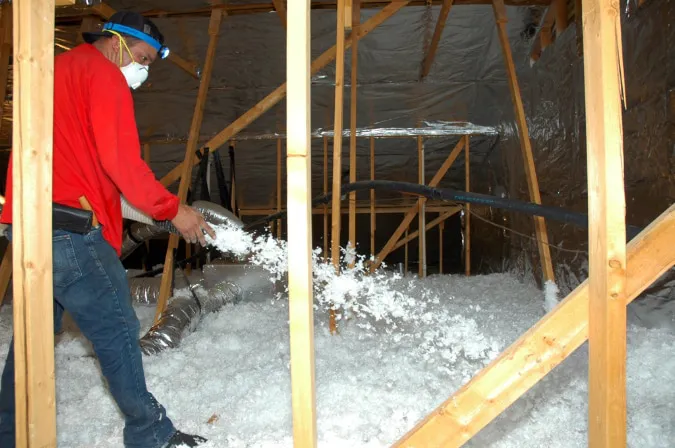
Blown-in fiberglass insulation is useful for covering broad attic floors and filling in around irregular framing and penetrations. Installers can add material to build a continuous layer across most existing attic assemblies, which is why it suits older homes where the framing was never laid out with insulation in mind.
Fiberglass batt insulation comes in pre-cut sections sized for standard framing cavities. Batts are effective where the cavity dimensions and access let each piece be fitted carefully, without gaps, folding or compression — and much less effective when they are forced into a space that does not match them.
The right choice is not the product that sounds more familiar. It depends on the attic layout, the existing insulation, the access, the R-value you are aiming for, and whether the old material should stay.
More insulation is not always the first step. If the attic holds wet, heavily contaminated, deteriorated or badly compacted material, covering it hides the problem instead of solving it. Professional attic insulation removal may be the right first move before air sealing or installing a clean, even layer.
Removal also makes sense when extensive electrical, mechanical or ceiling work needs clear access. And whatever the cause of any moisture, roof leak or ventilation problem, it should be corrected before new insulation goes down — otherwise you are paying to bury the same issue twice.
No. A radiant barrier foil system and fiberglass insulation address different forms of heat transfer. Fiberglass resists heat conducting through the ceiling assembly. Radiant barrier foil is installed with an adjacent air space to reduce radiant heat coming off the roof deck toward the attic below.
In a hot, sunny climate a homeowner may benefit from improving attic-floor insulation, from installing radiant barrier foil, or from both. The existing attic conditions should decide the order of work — and if you want the longer explanation of how radiant barrier actually works and what the research measured, we wrote that up separately in does radiant barrier really work.
That sequence gives a far more useful answer than picking a number of inches without seeing the house.
The current prescriptive ceiling value for this climate zone is R-38, which in blown fiberglass generally means somewhere in the range of twelve to sixteen inches of settled depth. But that number describes a target, not a diagnosis. What matters is what is up there now, how evenly it is spread, and whether anything has to be corrected first.
Often yes, provided the existing material is dry, reasonably clean and suitable to stay. Damaged or contaminated material should be evaluated before anything is laid over it — covering a problem does not fix it, and it makes the eventual repair more expensive.
Material type and average depth give you a rough figure, but uneven coverage and compression make that estimate unreliable. The quick version from the hatch: if the insulation is level with or below the tops of the ceiling joists, you are well under current standards. A full inspection gives you the real picture.
No, and any contractor who says otherwise has not looked. Insulation is often part of the answer, but duct leakage, air leakage, window exposure, solar orientation and HVAC balance all contribute to a room that will not hold temperature. We will tell you which one we think is driving it.
Most straightforward installations are a single day, working from the attic access rather than through your living space wherever possible. Removal jobs and difficult access take longer. You will know the expected scope before anyone starts.
No. The evaluation and the written estimate are free. Tell us what you have noticed — warm rooms, uneven temperatures, visible insulation problems — and we will look at what is actually there before recommending anything.
The attic evaluation and written estimate are free. We measure actual depth in several places, look for the thin spots and tell you honestly what your attic needs. Serving Austin, Round Rock, Cedar Park, Georgetown, Leander, Pflugerville, Kyle, Buda, Hutto, Manor and Lakeway.