Mon-Sat: 8:00am-7:00pm

Radiant barrier foil and attic insulation get discussed as competing upgrades, but they do different jobs entirely. In most Austin homes the useful question is not which one is better. It is which type of heat transfer is causing your problem, and what the attic already has.
Fiberglass insulation slows heat conducting through the ceiling assembly. Radiant barrier foil reduces radiant heat coming off the underside of a sun-heated roof. Neither one replaces the other, and a contractor who tells you otherwise is selling rather than diagnosing.
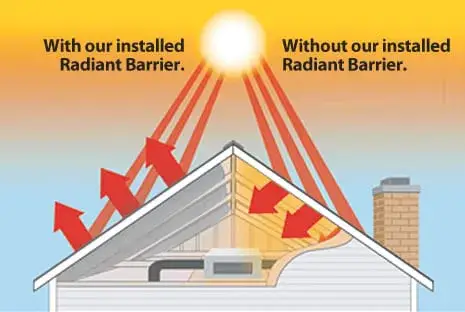
Attic heat moves three ways. Conduction carries it through solid materials. Convection moves it through air. Radiation carries it across an air space from a warmer surface toward a cooler one, needing no air at all.
Fiberglass insulation resists conductive heat flow between the attic and the living space. A radiant barrier is a highly reflective, low-emissivity material positioned next to an air space to cut radiant heat transfer. The U.S. Department of Energy notes that radiant barriers reduce radiant heat gain and are generally most useful in hot climates — which is why they get discussed far more in Austin than in Denver.
Fiberglass slows heat flow through the attic floor and ceiling. In hot weather it reduces the rate at which attic heat reaches your conditioned rooms. In cool weather it resists heat escaping the other direction.
It has to be installed correctly to do that. Gaps, compressed batts, thin spots and displaced loose-fill all break the continuity of the thermal layer, and the weakest section sets the result. Air leaks around fixtures and penetrations bypass insulation entirely, so adding more material without inspecting the attic can miss the actual problem completely.
We install both blown-in fiberglass and fiberglass batt insulation. Which one suits your attic depends on the framing, the access, the existing material and the coverage needed.
Radiant barrier foil is installed along the underside of the roof framing with the reflective surface facing an air space. As the roof heats through the afternoon, the foil sends far less radiant energy down into the attic than bare decking would.
It is not conventional insulation, and it should never be sold to you with an R-value attached. Both the EPA and the Federal Trade Commission have stated that radiant barrier products do not carry a meaningful R-value — there is no accepted test method for one. Its performance depends on installation method, orientation, the adjacent air space, roof exposure, duct location and the rest of the attic conditions.
Proper radiant barrier foil installation in Austin keeps ventilation paths open and keeps the material well clear of electrical components. If you want the full explanation of where the technology came from and what federal research measured, we covered that in does radiant barrier really work.
| Question | Fiberglass Insulation | Radiant Barrier Foil |
|---|---|---|
| Primary job | Resists conductive heat flow | Reduces radiant heat transfer |
| Typical location | Attic floor or framing cavities | Roof framing beside an air space |
| Performance measure | R-value | Reflectivity and emissivity — not R-value |
| Needs an air gap? | No | Yes, always |
| Can it replace the other? | Not automatically | No — it is not attic-floor insulation |
Improving the insulation layer is usually the logical first move when the attic has exposed ceiling areas, badly uneven coverage, compressed or missing batts, or material sitting well below the tops of the ceiling joists. Moisture-damaged or contaminated material may need professional insulation removal before anything new goes down.
Air leakage belongs in the same conversation. ENERGY STAR emphasizes combining insulation improvements with appropriate air sealing, because heat and air move through gaps that insulation alone does not close. Sealing the ceiling penetrations first often makes the insulation you already own work better.

Radiant barrier becomes genuinely valuable when an Austin attic takes strong solar gain at the roof, when HVAC ducts or the air handler sit in the attic, and when the roof framing gives a suitable installation surface. That middle condition matters more than most people realize — Oak Ridge National Laboratory found that duct location and condition changed radiant barrier savings by roughly a factor of two. Ducts running through a 130-degree attic are losing cooled air the whole way to your rooms.
The attic still needs adequate ventilation and a properly installed insulation layer at the ceiling. Foil has to go in as a system, not as decorative sheeting. Dust accumulation, installation flat against another surface without the required air space, blocked vents and incomplete coverage all reduce or eliminate the benefit.
A combined approach closes three different pathways:
That does not mean every home needs all three. An attic with solid insulation but heavy roof-driven heat presents a very different opportunity from one with large bare areas or water-damaged material. The inspection comes before the recommendation — not the other way around.
No contractor can responsibly promise the same savings percentage to every Austin home. Results move with roof color and orientation, ductwork, HVAC efficiency, thermostat habits, existing insulation, air leakage, shade, home size and how the house is actually lived in.
If someone quotes you a specific percentage before they have been in your attic, they are guessing. The better goal is to correct the visible deficiencies, choose materials that match the actual heat-transfer problem, and install them to suit how the attic is built.
In most cases, whichever addresses the bigger deficiency. If your insulation is thin, uneven or damaged, fix that first — a radiant barrier over a poor insulation layer is treating the smaller problem. If your insulation is in good condition and the attic is still brutal because of roof exposure and ductwork up there, radiant barrier is the upgrade with room to work.
We do not recommend it. Roof-rafter installation keeps the foil next to the air space it needs and keeps it out of the dust. Foil laid across attic-floor insulation collects dust, which raises emissivity and reduces performance over time, and it can trap moisture underneath in a humid climate.
Not necessarily. Dry, serviceable insulation can usually stay right where it is. Wet, contaminated or badly damaged material should be dealt with on its own merits, independent of whether you are adding foil.
Its main value in this climate is the cooling season, which is most of the year here. It does reduce radiant heat transfer in both directions, but Austin’s heating season is short enough that the summer performance is what drives the decision.
Maybe, but do not assume it. One stubbornly hot room is just as often duct leakage, a duct run that is too long, poor return air, or a gap in coverage directly above that room. We would rather find the actual cause than sell you an attic-wide upgrade that does not address it.
Have someone look. We measure existing depth in several places, check the roof assembly and ventilation, note where your ducts run, and tell you which pathway is costing you the most. The evaluation and written estimate are free, and we will tell you if the answer is that your attic is already in decent shape.
We evaluate the existing insulation, the roof assembly, the ventilation and where your ducts run, then tell you which upgrade actually addresses your problem — or that your attic is already in good shape. The evaluation and written estimate are free. Serving Austin, Round Rock, Cedar Park, Georgetown, Leander, Pflugerville, Kyle, Buda, Hutto, Manor and Lakeway.